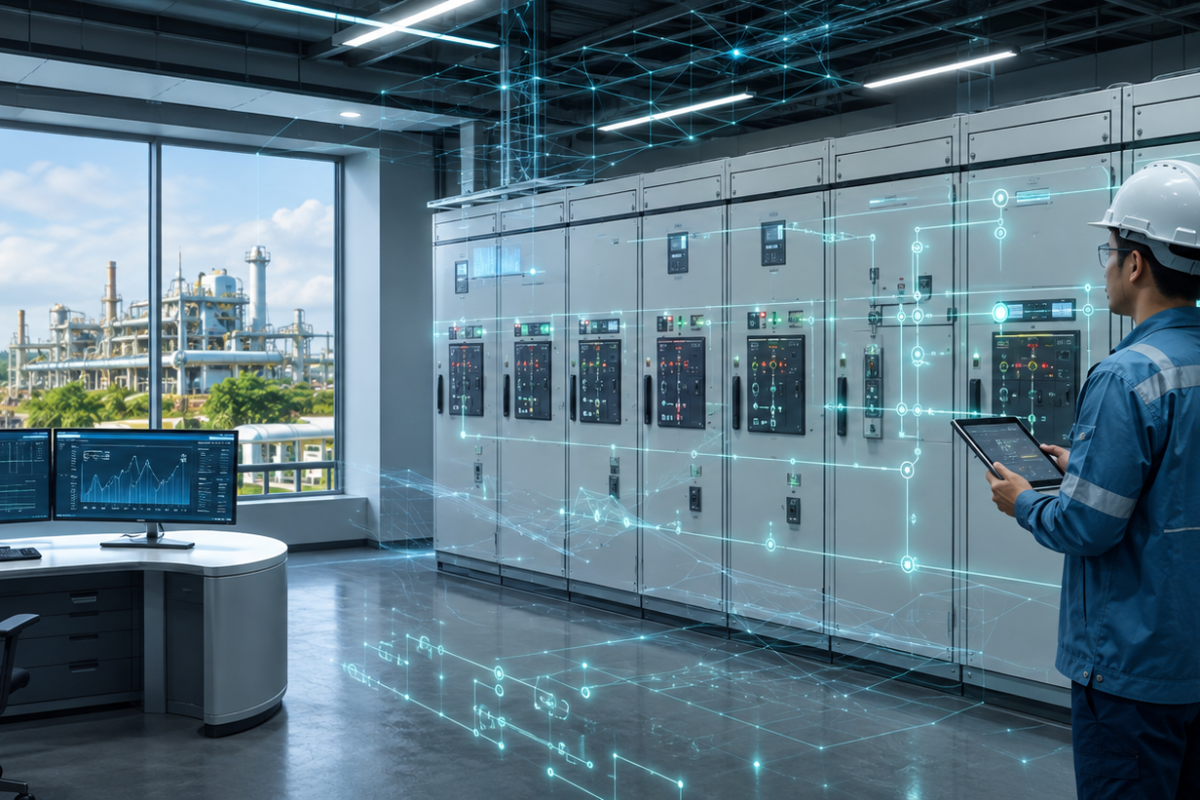
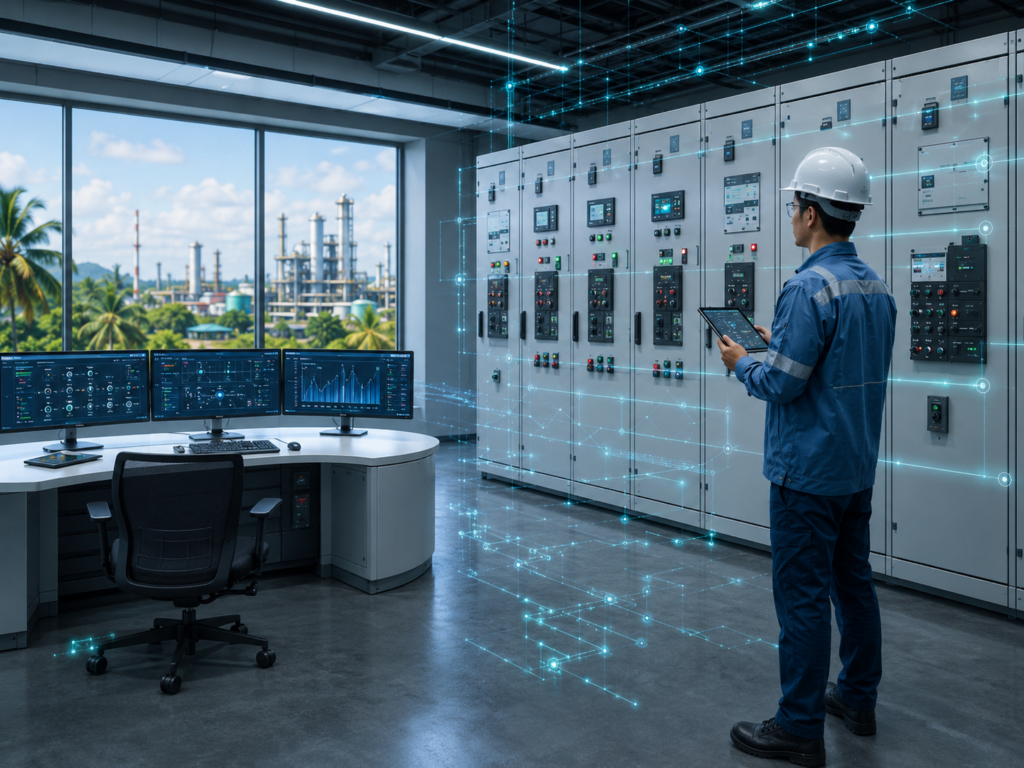
Arc Flash studies in Southeast Asia, including Indonesia, involve a completely different level of complexity compared with many conventional industrial facilities in Europe.
INFOCOM Ltd’s experience across more than ten industrial sites in the region demonstrates that electrical safety is not merely about compliance with standards. It is directly connected to personnel safety, production reliability and the ability of an industrial plant to continue operating without critical interruptions.
Arc Flash calculations are only part of the project
An Arc Flash calculation alone does not provide a complete understanding of an industrial power system.
As part of its projects, INFOCOM performs comprehensive electrical power system studies, which may include:
- updating single-line diagrams and network topology;
- reviewing cables, circuit breakers and fuses;
- analysing and verifying protective relay settings;
- inspecting the actual condition of electrical equipment;
- performing short-circuit studies;
- modelling multiple operating configurations;
- calculating Arc Flash incident energy and risk boundaries;
- developing technical and organisational recommendations.
The final result is therefore much more than an incident energy value.
The customer receives a structured assessment of the electrical system together with practical recommendations designed to improve personnel safety, power system reliability and the overall resilience of the facility.
Indonesia: when there is no conventional power supply
One of the key characteristics of the industrial facilities where INFOCOM has worked in Indonesia is their high level of energy independence.
Many production sites are located in remote areas, sometimes surrounded by hundreds of hectares of palm plantations, where a conventional and reliable public utility connection cannot be taken for granted.
Electricity therefore has to be generated locally using combinations of:
- diesel generators;
- steam boilers;
- steam turbines;
- multiple local generation sources operating in parallel.
Depending on current production requirements, these sources can operate in different combinations.
As a result, a single industrial facility may have 10 to 12 different power system operating scenarios.
Each scenario can produce different fault current levels, power-flow directions and Arc Flash conditions.
This means that studying only one “normal” operating mode is not sufficient.
Digital power system modelling reveals the critical scenarios
Complex electrical networks require detailed modelling of the actual system and simulation of all relevant operating conditions.
Such a digital model of the electrical network allows engineers to determine:
- which combinations of power sources create the highest short-circuit currents;
- where the highest Arc Flash risks occur;
- whether protective devices operate quickly enough;
- whether relay settings are correctly coordinated;
- where a single fault could result in an unnecessarily large production outage;
- which technical measures can reduce risk most effectively.
For systems of this complexity, simplified tables or generic calculations are not enough.
The electrical network has to be assessed according to its real configuration and actual operating conditions.
Humidity, ageing equipment and demanding environmental conditions
The complexity of projects in Indonesia is not limited to power generation.
Electrical equipment often operates under environmental conditions that can significantly affect its service life and reliability.
Typical challenges include:
- high humidity;
- high ambient temperatures;
- aggressive industrial environments;
- remote locations with limited service infrastructure;
- ageing electrical equipment;
- systems designed 20 or 30 years ago, before today’s Arc Flash protection practices became widespread.
Similar technical challenges can also be found in other Southeast Asian countries, including Malaysia and Vietnam.
The goal is not to produce a report. The goal is to reduce risk.
A technically correct report does not improve electrical safety unless its recommendations are understood and implemented.
INFOCOM therefore focuses on making the results practical and actionable.
Identified issues can be prioritised according to their severity, for example:
High – Medium – Low
This allows the customer to clearly understand:
- which issues represent the highest safety risk;
- which measures should be implemented first;
- which improvements can be scheduled during planned maintenance;
- which changes can also improve overall power system reliability.
The objective is not to produce hundreds of pages of documentation simply for compliance purposes.
The objective is to provide a clear roadmap for improving the safety and reliability of the electrical system.
What a five-year reassessment can reveal
INFOCOM has returned to some industrial facilities in Indonesia approximately five years after the original study.
These follow-up assessments provide valuable insight.
Where recommended measures had been implemented, risks were reduced and the electrical system demonstrated more stable operation.
Where recommendations had not been followed, the original problems often remained — and in some cases had become more significant due to equipment ageing or changes in the power system.
Industrial electrical networks are not static. Over several years, facilities may change:
- power sources;
- transformers;
- motors;
- production technologies;
- protection devices;
- switchgear configurations;
- relay settings.
For this reason, international electrical safety practices, including requirements associated with NFPA 70E, provide for periodic review of Arc Flash risk assessments, particularly after significant changes and at intervals not exceeding five years.
Arc Flash analysis is an investment in operational continuity
A professional Arc Flash study should not be viewed only as a safety expense.
It can help industrial companies:
- protect employees from the consequences of electrical arc events;
- reduce the probability of serious electrical failures;
- identify weak points in the power distribution network;
- improve protective device coordination;
- limit the extent of potential production outages;
- support compliance with international electrical safety requirements;
- reduce potential financial losses caused by unplanned downtime.
At industrial facilities where several hours or days of downtime can translate into substantial losses, understanding the real condition of the electrical network has a direct economic value.
INFOCOM as an engineering partner for complex power systems
Experience from Indonesia and other international projects demonstrates that complex power systems cannot be properly assessed through software calculations alone.
Effective studies require a combination of field data, equipment inspection, network modelling, protection system analysis and practical engineering expertise.
INFOCOM approaches each project as an engineering partner — from collecting and verifying input data and building the electrical network model to identifying risks, developing recommendations and reviewing the implementation of corrective measures.