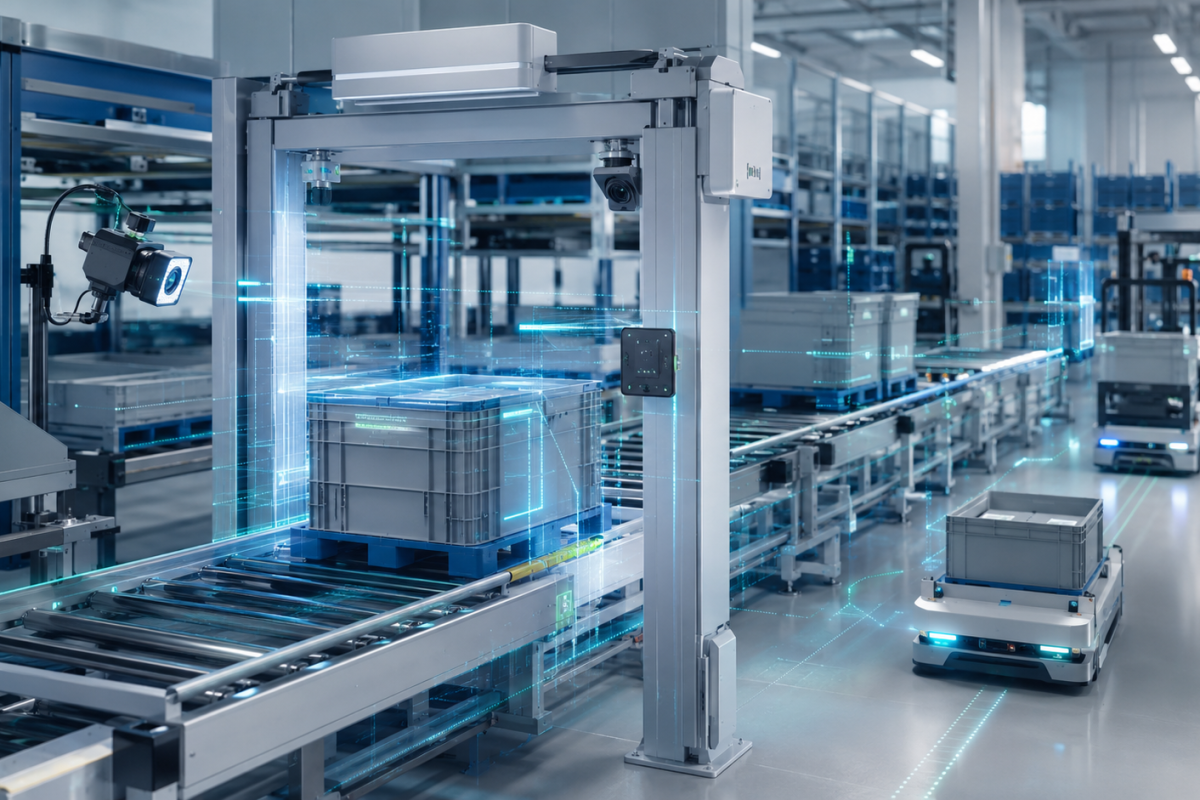
Accurate identification of vehicles, materials and movements within an industrial site is becoming an important part of modern logistics. Manual registration can be slow, vulnerable to errors and difficult to manage as the number of daily movements increases.
INFOCOM uses RFID, machine vision and video analytics to automate identification and control processes in industrial and logistics environments.
By combining several technologies, companies can create systems that automatically recognise objects, record their movements and provide up-to-date operational information without continuous manual intervention.
RFID: automatic identification without manual data entry
RFID – Radio Frequency Identification – enables an object equipped with an RFID tag to be identified using radio signals.
A tag can be assigned to:
- a truck or other vehicle,
- handling equipment,
- a container,
- a pallet,
- material or a product,
- an employee or authorised person.
When the tagged object enters the reading range of an RFID reader, the system automatically identifies it and can immediately transfer the information to a higher-level control or information system.
There is therefore no need to manually enter vehicle numbers, scan documents or repeatedly enter the same information at each checkpoint.
Where can RFID systems be used?
INFOCOM implements automatic identification solutions wherever accurate monitoring of vehicles or objects is required.
Typical applications include:
Vehicle identification
The system can automatically identify a vehicle entering or leaving an industrial facility.
The identification data can then be linked to an order, delivery, cargo or access authorisation.
Movement control within industrial sites
RFID can record when a specific vehicle or object enters a defined area, where it is located and when it leaves.
This provides operators with greater visibility into actual movement across the site.
Cargo tracking
Automatic identification can help connect individual vehicles with specific loads or logistics operations.
The result is more accurate records and greater transparency throughout the logistics process.
Access automation
Identification systems can be integrated with gates, barriers and other access-control equipment.
Once authorisation has been verified, the entire process can take place automatically without operator intervention.
When RFID alone is not enough: machine vision and video analytics
Not every vehicle or object carries an RFID tag.
In practice, a tag may also be unavailable, damaged or missing when a vehicle enters the site for the first time.
This is where RFID systems can be supplemented with machine vision, video analytics and artificial intelligence algorithms.
Cameras combined with image-processing software can analyse the scene and identify relevant objects.
Such technology can be used for:
- vehicle recognition,
- object identification,
- monitoring movement within defined areas,
- verifying information received from RFID systems,
- automated identification where an RFID tag is not available.
RFID + machine vision: improving identification reliability
The greatest potential comes from combining several independent identification methods.
RFID provides a unique electronic identifier, while a camera system can independently verify what is physically present at the location.
The system can therefore compare data from several sources.
For example, when an RFID reader identifies a specific vehicle and the camera system simultaneously confirms its presence, the operator gains an additional layer of verification.
This approach can improve:
- identification accuracy,
- reliability of records,
- logistics transparency,
- the level of automation,
- control over vehicle and material movements.
From individual devices to an integrated system
An RFID reader or a camera on its own represents only one component of an automation solution.
The real value is created when these technologies are integrated with the company’s existing systems.
Data from RFID readers, cameras and other sensors can be processed and transferred to:
- industrial control systems,
- SCADA platforms,
- databases,
- logistics systems,
- enterprise information systems,
- access-control systems.
The entire process can therefore be automated from object identification through to the required operational action.
Experience from real industrial applications
INFOCOM has experience implementing such solutions for different types of facilities, including:
- grain storage and elevator facilities,
- logistics complexes,
- industrial enterprises.
Every project requires an individual approach.
Distances between identification points, the number and type of vehicles, environmental conditions and the systems that need to be integrated can vary significantly.
For this reason, RFID and machine-vision technology should not be considered in isolation. They need to be designed as part of the complete technological and logistics process.
Automation creates data that can be used for further optimisation
Digital identification provides much more than automated access control.
Every movement can also create a digital record.
A company can therefore obtain information about:
- when a vehicle entered the site,
- how long it remained there,
- which checkpoints it passed,
- when it left the facility,
- which logistics process it was associated with.
This information can subsequently be used for process analysis and further operational optimisation.
INFOCOM: RFID, machine vision and industrial automation in one solution
Modern industrial logistics requires more than basic record keeping.
It requires systems capable of identifying, monitoring, recording and connecting information in real time.
The combination of RFID, machine vision, video analytics and integration with industrial information systems makes it possible to reduce manual operations while giving companies a much clearer view of their processes.
This integrated approach is what INFOCOM applies when developing automation solutions for logistics and industrial facilities.