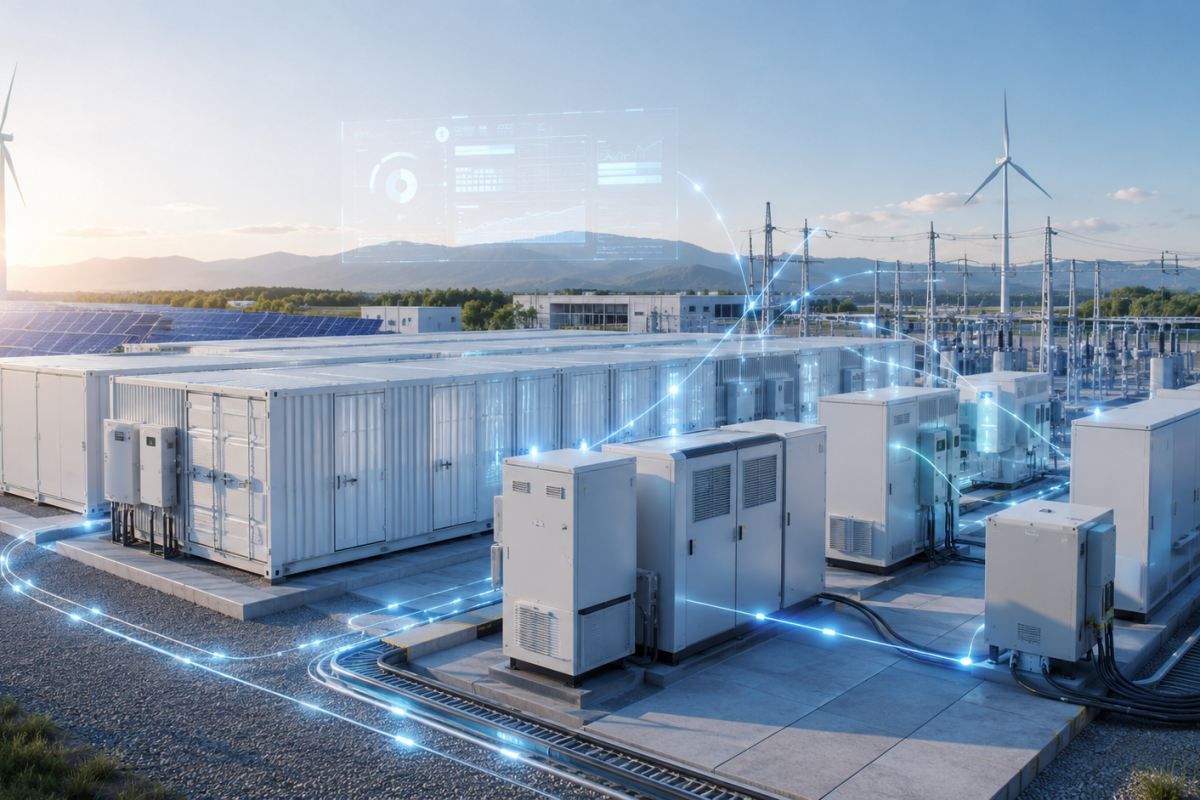
Increasing power requirements, the growth of photovoltaics, EV charging and industrial automation are changing the way companies manage electricity.
One technology providing significantly greater flexibility is the Battery Energy Storage System – BESS.
Its purpose is not simply to “store electricity for later”.
A properly engineered BESS can help a business:
- reduce demand peaks,
- increase self-consumption of photovoltaic energy,
- use available grid connection capacity more effectively,
- support selected loads during power interruptions,
- optimise electricity consumption according to prices or tariffs,
- reduce dependence on certain backup generation sources,
- automatically manage energy flows.
The actual benefit always depends on the system design and the use case for which it is implemented.
How does a BESS work?
The basic principle is straightforward.
When energy is available but is not required immediately by the facility, the battery system can store it.
The energy can then be supplied back to the site’s electrical network when required.
The source may be:
- the public electricity grid,
- a photovoltaic installation,
- another local generation source.
A control system determines when the battery should charge and when it should discharge according to the selected operating strategy.
A modern BESS is therefore much more than a group of batteries. It combines battery modules, power electronics, protection, measurement and intelligent control.
Peak shaving: reducing maximum power demand
One of the most common industrial applications is peak shaving.
Consider a facility with relatively stable normal consumption but several high-power loads that operate for short periods during the day.
These may include:
- large electric motors,
- compressors,
- production lines,
- industrial furnaces,
- cooling systems,
- high-power EV chargers.
These short periods can create significant demand peaks.
During such a peak, a BESS can supply part of the required power from the battery.
Instead of the entire instantaneous load being supplied by the grid connection, part of it is provided locally.
This approach may be particularly useful where connection capacity is limited or where the applicable grid or tariff structure is affected by reserved or maximum demand.
Increasing photovoltaic self-consumption
Solar generation follows sunlight conditions rather than a company’s exact consumption profile.
Generation and demand therefore do not always coincide.
A typical situation may look like this:
- photovoltaic production is high around midday,
- the facility cannot consume all of the electricity immediately,
- later in the day demand increases while photovoltaic output falls.
A BESS can store part of the surplus and make it available later.
This can increase the proportion of locally generated electricity consumed directly by the facility.
Instead of immediately exporting all surplus generation, a business may be able to use more of that energy when it is actually required.
Charging when electricity is cheaper
Another possible operating strategy is to control the battery according to electricity prices.
Where a company’s tariff or electricity contract includes meaningful price differences over time, the BESS can potentially:
- charge during lower-cost periods,
- discharge during higher-cost periods.
This approach is often referred to as energy arbitrage.
Its economic value, however, depends on several factors:
- electricity price spreads,
- tariff structure,
- round-trip efficiency,
- number of battery cycles,
- battery degradation,
- control strategy.
It should therefore not be assumed that every battery system automatically creates savings simply by charging at night and discharging during the day.
The individual site and its electricity contract must be analysed.
BESS and EV charging infrastructure
High-power DC charging can significantly increase the instantaneous electrical demand of a facility.
If an industrial site, logistics centre or public car park plans to install several fast-charging points, the available grid connection may not always provide sufficient power.
One possible architecture is:
grid connection + BESS + intelligent power management.
During periods of vehicle charging, the battery can temporarily provide additional power and recharge later when site demand is lower.
Whether this is technically and economically appropriate depends on charger power, utilisation, required battery capacity and the existing electrical infrastructure.
Can a BESS provide backup power?
Yes — but not automatically.
Installing a battery does not by itself mean that an entire facility will continue operating during a grid outage.
If backup operation is required, the system must be specifically engineered for it.
The design may need to consider:
- disconnection from the utility grid,
- creation of an islanded electrical network,
- transfer or switching arrangements,
- priority loads,
- required backup power,
- required backup duration,
- protection and control strategy.
A BESS may therefore be configured to support selected critical loads rather than the entire facility.
Reducing diesel generator operation
At sites where diesel generators are used for backup or supplementary generation, battery storage can form part of a hybrid power system.
The battery may handle short-duration power fluctuations or certain operating periods without requiring the generator to start immediately.
Depending on the architecture, this may help:
- reduce generator running hours,
- lower fuel consumption,
- reduce noise,
- optimise hybrid-system operation.
However, a BESS does not automatically replace a diesel generator. The appropriate solution depends on backup requirements and the operating profile of the facility.
The EMS determines how the battery is used
The value of an energy storage system often depends as much on its control strategy as on the battery itself.
An Energy Management System – EMS can continuously monitor:
- current site consumption,
- photovoltaic generation,
- battery state of charge,
- instantaneous power,
- grid connection limits,
- technology requirements,
- available operating modes.
The EMS then determines whether the battery should charge, discharge or preserve capacity for another purpose.
The same battery can therefore perform several functions during the day according to defined priorities.
Correct sizing determines performance
When selecting a BESS, looking only at the kWh figure is not enough.
At least two parameters are fundamental:
Power – kW or MW
Determines how much power the system can deliver at a given moment.
Energy capacity – kWh or MWh
Determines how much energy the system can store.
A facility that needs to cover a high but short-duration power peak requires a very different configuration from a site requiring several hours of backup operation.
Correct sizing therefore requires analysis of:
- consumption profiles,
- maximum demand,
- photovoltaic generation,
- required operating modes,
- expected cycling,
- available installation space,
- existing electrical infrastructure.
When does BESS make sense for a business?
Battery storage is most valuable when it solves a clearly defined energy problem.
Examples include:
- high demand peaks,
- insufficient available connection capacity,
- significant photovoltaic surplus,
- planned production expansion,
- high-power EV charging,
- backup-power requirements,
- the need for more flexible energy management.
The correct process is therefore to identify the operational requirement first and size the battery system afterwards.
BESS as part of modern energy infrastructure
Battery energy storage can give industrial and commercial facilities significantly greater flexibility in the way they use electricity.
The value, however, does not come simply from installing a battery container.
It comes from combining:
load analysis + correct sizing + electrical integration + intelligent control.
BESS should therefore be engineered as part of the facility’s complete energy infrastructure rather than treated as an isolated device.
When properly designed, energy storage can help companies use existing electrical infrastructure more effectively, increase renewable-energy self-consumption, reduce demand peaks and create a more flexible power system.