In high-volume railway logistics, even a seemingly simple task — correctly recording the identification number of every wagon — can become a source of delays and errors.
With manual identification, an operator must read each number, record it and transfer the information into a logistics or accounting system. When dozens or hundreds of wagons are processed, this small task becomes a repetitive operation consuming time and creating opportunities for human error.
INFOCOM therefore implemented an automated rail wagon number recognition system at a company operating in the logistics sector.
The resulting solution processes identification information within several seconds and can achieve recognition accuracy of up to 99%.
The challenge: many movements create large volumes of data
In railway logistics, every wagon has to be connected with the correct operational information.
This may include:
- wagon identification number,
- date and time of passage,
- direction of movement,
- logistics operation,
- cargo information,
- weighing data,
- material receipt or dispatch.
When these records are created manually, their quality depends directly on operator accuracy.
Typical risks include:
- incorrectly entered wagon numbers,
- missed wagons,
- delayed data entry,
- discrepancies between physical wagon movements and digital records,
- difficulties when tracing past events.
The objective of the project was therefore not simply to replace an operator with a camera.
The objective was to automatically connect the physical movement of a wagon with its digital record.
The solution: cameras, machine vision, AI and OCR
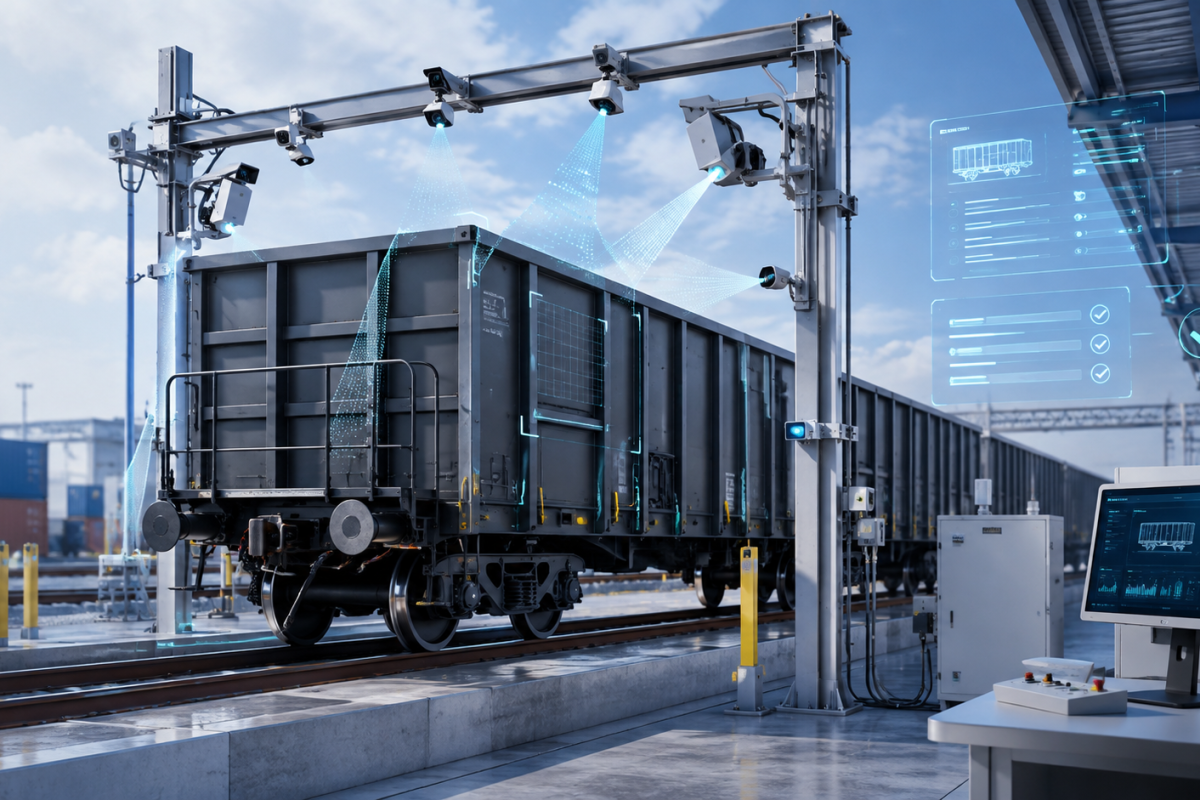
The INFOCOM solution uses images from industrial cameras together with automated image-processing algorithms.
When a wagon passes the recognition point, several operations take place.
The system captures an image and detects the area containing the wagon identification number.
Machine vision, artificial intelligence and OCR – Optical Character Recognition are then used to analyse the relevant part of the image.
The system recognises the characters, evaluates the result and prepares the wagon identifier for further processing.
The complete process takes only a few seconds.
Why basic OCR is not enough
A railway environment is much more challenging than scanning a clean printed document.
Wagons can be:
- dirty,
- scratched,
- of different ages,
- captured under different lighting conditions,
- marked on surfaces with varying contrast,
- photographed while moving.
Identification numbers themselves may also be partially obscured or difficult to read.
For this reason, the system cannot rely on simple image-to-text conversion alone.
Combining AI, image-processing algorithms and OCR helps detect the relevant area first and then accurately interpret the wagon number.
Under the conditions of the implemented project, recognition accuracy can reach up to 99%.
Seconds instead of manual data processing
Processing speed was another important aspect of the project.
Recognition and processing require only several seconds.
This allows identification to become a natural part of the logistics process rather than an additional manual operation.
The advantage becomes increasingly significant as traffic volumes grow.
Instead of operators manually entering individual numbers, digital records are produced automatically as the wagons move through the facility.
Recognition is only the first step
Identifying a wagon number would provide limited business value if the result remained isolated inside the camera system.
A key part of the solution is therefore integration with the company’s other systems.
The recognised wagon identifier can be transferred to:
- logistics databases,
- weighing systems,
- inbound and outbound records,
- material-flow tracking,
- dispatching systems,
- enterprise information systems.
A physical wagon movement can therefore automatically generate data for subsequent business processes.
Connecting wagon recognition with weighing
Automatic identification becomes particularly valuable when combined with railway weighing systems.
The solution can associate an individual weighing result with the correct wagon.
A digital record may therefore follow a structure such as:
wagon number → passage time → weight → logistics operation
This eliminates many situations in which staff would otherwise have to determine manually which weighing record belongs to which wagon.
What did automation improve?
The implementation addressed three main areas.
1. Fewer recording errors
Automatic recognition reduces the need to manually copy identification numbers.
This lowers the risk of typing mistakes and other errors caused by repetitive data entry.
2. Better wagon records
Each recognised wagon can automatically create a digital event.
The company therefore gains greater visibility into actual wagon movements across the logistics process.
3. Faster data processing
When manual identification and subsequent data entry are removed, information can be processed almost simultaneously with the physical movement of the wagon.
A digital history of wagon movements
Automation also makes it possible to create a chronological record of events.
The company can subsequently determine:
- which wagon passed the identification point,
- when it passed,
- in which direction it travelled,
- which weighing result or process was associated with it.
These records improve operational transparency and make investigation of unusual events easier.
Reducing dependence on the human factor
Automation does not eliminate people from logistics processes.
Instead, it changes their role.
Rather than repeatedly transcribing wagon numbers, employees can focus on monitoring operations and managing exceptions.
The system handles the repetitive identification activity consistently and at speed.
Successful recognition requires more than software
Recognition accuracy is not determined by the AI algorithm alone.
The entire technical design affects performance, including:
- camera positioning,
- viewing angles,
- image resolution,
- wagon speed,
- lighting,
- environmental conditions,
- communication infrastructure,
- integration with enterprise systems.
For this reason, the system has to be engineered according to the actual site and operating conditions.
From a camera to an automated logistics process
The greatest value of the project is not simply the ability to read a railway wagon number.
Value is created when the information automatically reaches the systems and processes where it is needed.
By integrating machine vision, AI, OCR and enterprise systems, INFOCOM delivered a solution that:
- automatically identifies railway wagons,
- processes data within several seconds,
- achieves accuracy of up to 99%,
- reduces manual operations,
- improves logistics data quality,
- creates a foundation for further automation.
Digital logistics does not begin with entering data into software. It begins with acquiring accurate data automatically from the physical process itself.