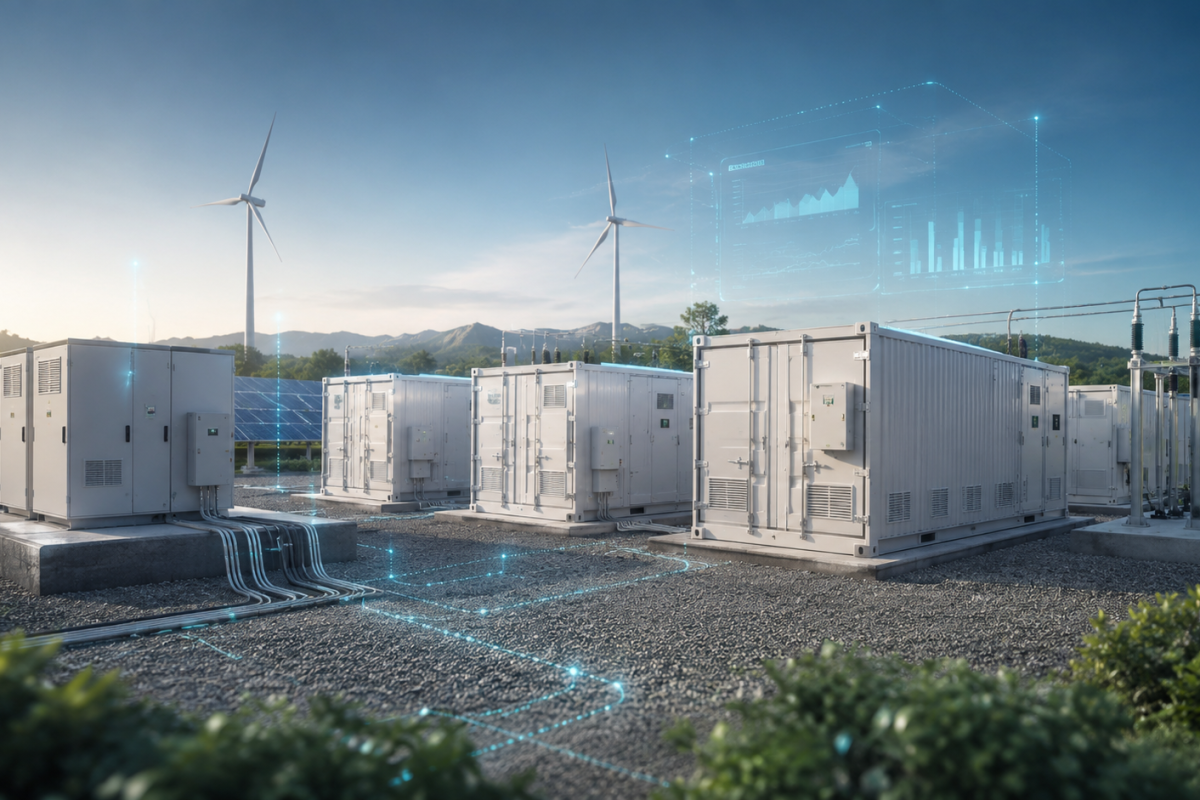
Battery Energy Storage Systems – BESS are becoming an increasingly important part of modern energy infrastructure.
For industrial facilities, energy projects, logistics centres and commercial sites, however, installing energy storage is not simply a matter of purchasing a battery container.
To achieve the intended result, the system must be correctly designed according to the actual load profile, available electrical capacity, existing infrastructure and the way the storage system will be operated.
INFOCOM works with Hellonext, CATL and PotisEdge to provide customers with an integrated approach to the design and implementation of battery energy storage systems.
A BESS is more than a battery
At first glance, the operating principle seems straightforward: electricity is stored in batteries and used later when required.
A complete BESS, however, consists of several interconnected technologies.
Depending on the project, the system may include:
- battery modules,
- a Battery Management System – BMS,
- power conversion systems – PCS,
- an Energy Management System – EMS,
- transformers and switchgear,
- protection equipment,
- metering and monitoring,
- thermal management systems,
- safety and fire-protection systems,
- communication interfaces.
The performance of the final installation therefore depends on much more than the quality of the battery cells.
It also depends on how the complete system is sized, engineered, controlled and integrated into the customer’s electrical infrastructure.
Every project requires a different configuration
There is no single BESS configuration suitable for every facility.
A manufacturing plant with significant demand peaks has different requirements from a logistics centre equipped with photovoltaics.
A site planning new production machinery or high-power charging infrastructure may require a completely different solution.
Before selecting equipment, engineers therefore need to understand factors such as:
- the site’s actual consumption profile,
- peak demand,
- available grid connection capacity,
- the characteristics of individual loads,
- existing or planned photovoltaic generation,
- required battery power,
- required storage capacity,
- expected cycling,
- operating strategy,
- connection requirements.
Only after these parameters have been analysed can the system be sized correctly.
kW and kWh are different parameters
One of the fundamental considerations in BESS design is the relationship between power and energy capacity.
Power, expressed in kW or MW, determines how much power the storage system can deliver or absorb at a given moment.
Capacity, expressed in kWh or MWh, determines how much energy the system can store.
Some applications require high power for a relatively short period.
Others require a lower output that can be maintained for several hours.
An unsuitable relationship between power and capacity may result in a system that is technically operational but poorly matched to the actual application.
Where can BESS provide value?
The exact use case depends on the facility and the control strategy.
In industrial and commercial applications, energy storage can support several functions.
Peak demand management
When electricity demand increases rapidly, the battery can temporarily provide part of the required power and reduce the instantaneous load on the site’s electrical connection.
This may be useful for processes with significant short-term demand peaks.
Increasing the use of photovoltaic generation
When a photovoltaic installation generates more electricity than the site is consuming at that moment, part of the surplus can be stored.
The stored energy can then be used later when solar production falls and site demand increases.
Supporting new electrical loads
Production expansion, new machinery or the deployment of EV charging infrastructure can significantly increase power requirements.
In suitable projects, correctly designed storage can provide additional flexibility in the way existing electrical capacity is used.
Backup operation
Depending on system architecture, a BESS may also be designed to support selected loads during temporary power interruptions.
Backup functionality must, however, be considered during the design phase rather than added as an assumption after installation.
Energy management
When connected to an EMS, the storage system can automatically determine when to charge and discharge.
The control strategy can take into account current site demand, photovoltaic production, battery state of charge and other operating parameters.
INFOCOM: more than equipment supply
In BESS projects, INFOCOM’s role is not limited to delivering a specific battery system.
The objective of a system integrator is to ensure that the new equipment operates correctly as part of the customer’s complete electrical infrastructure.
A project may therefore involve:
- analysing customer requirements,
- collecting and evaluating operating data,
- sizing BESS power and capacity,
- selecting an appropriate technical solution,
- designing the electrical connection,
- engineering the system,
- coordinating protection,
- integrating control and monitoring systems,
- connecting the BESS to existing infrastructure,
- supporting commissioning,
- providing subsequent technical support.
This approach reduces the risk of purchasing technically advanced equipment that is not properly matched to the real requirements of the facility.
Hellonext, CATL and PotisEdge
Working with several manufacturers gives INFOCOM greater flexibility when selecting technology for different project requirements.
The portfolio includes solutions from:
- Hellonext,
- CATL,
- PotisEdge.
The most suitable configuration depends on the project, required power and capacity, operating strategy, existing electrical infrastructure and other technical parameters.
Integration into existing infrastructure is critical
Many BESS projects are implemented at existing industrial or commercial facilities.
The battery system therefore has to work together with existing switchgear, transformers, photovoltaic systems and production technologies.
Before installation, engineers may need to assess:
- available electrical capacity,
- network parameters,
- existing switchgear,
- transformers,
- short-circuit conditions,
- protective devices,
- communication interfaces,
- available installation space,
- cooling and safety requirements.
A BESS cannot be evaluated as an isolated device. It has to be engineered as part of the complete power system.
Control is as important as hardware
Modern energy storage requires intelligent control.
An EMS can continuously monitor parameters such as:
- current site consumption,
- photovoltaic generation,
- battery state of charge,
- required output,
- operating limits,
- equipment status.
Based on the configured operating strategy, the system can then determine when batteries should charge or discharge.
The control philosophy therefore has a major influence on how efficiently the BESS will be used during its operating life.
Incorrect sizing is one of the main project risks
When considering a BESS investment, it can be tempting to compare solutions primarily by purchase price or nominal storage capacity.
However, this does not necessarily result in the best technical solution.
An incorrectly designed system may be:
- too small for the required application,
- unnecessarily oversized,
- unsuitable for the existing connection,
- poorly controlled,
- inefficiently utilised.
A technical assessment should therefore come before final equipment selection.
From analysis to a complete energy system
Battery energy storage represents an important shift from traditional electrical infrastructure towards more flexible energy management.
A battery alone, however, does not automatically solve a facility’s energy challenges.
The result depends on the combination of suitable technology, accurate engineering, correct electrical integration and intelligent control.
INFOCOM therefore approaches BESS as a complete engineering project – from analysing site requirements and selecting the appropriate solution to integrating the system into existing infrastructure and supporting its operation.