Generator and cogeneration units often form part of critical energy infrastructure where high availability and stable operation are essential.
The generating equipment itself, however, is only one part of the solution.
To operate one or multiple units effectively, a facility needs to know:
- the current status of each unit,
- how much power it is producing,
- whether operating parameters remain within acceptable limits,
- when a fault occurred,
- what happened immediately before the fault,
- how individual units interact with the rest of the energy infrastructure.
This is the role of a SCADA-based monitoring, dispatching and control system.
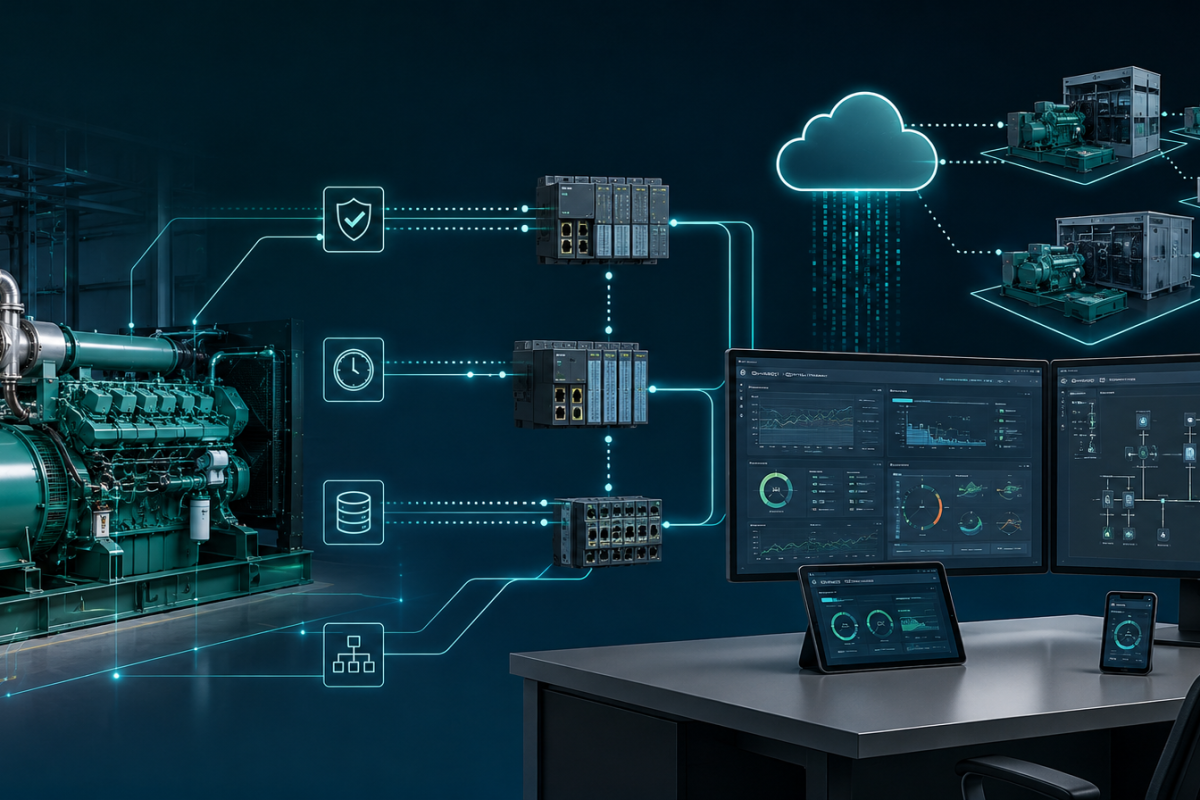
INFOCOM develops architectures that combine autonomous local control with centralised supervision and operational data collection.
The key principle: local control must remain autonomous
One of the fundamental principles of a reliable control architecture is local autonomy.
Each generating unit or technological node should be capable of performing essential control and protection functions even if communication with the central SCADA system is temporarily unavailable.
The local control level may provide:
- unit start and stop sequences,
- operating-condition monitoring,
- temperature and pressure supervision,
- electrical parameter monitoring,
- protection signal processing,
- safety interlocks,
- local fault indication.
This approach prevents critical equipment from becoming completely dependent on a single central communication point.
PLCs form the foundation of local automation
Programmable Logic Controllers – PLCs – operate at the equipment level.
They collect signals from sensors and devices, execute control algorithms and transmit the required information to higher system levels.
Typical parameters may include:
- generator output,
- voltage,
- current,
- frequency,
- rotational speed,
- temperatures,
- pressures,
- auxiliary equipment status,
- circuit breaker status,
- alarm and fault signals.
This creates a detailed real-time picture of the individual unit.
SCADA brings multiple units into one environment
When a facility operates several generator or cogeneration units, individual local panels are no longer enough.
Operators need a complete overview of the entire energy system.
SCADA collects information from the individual controllers and displays it through a common operator interface.
A dispatcher can monitor:
- current status of all units,
- instantaneous output,
- load distribution,
- active alarms,
- operating modes,
- fault history,
- parameter trends.
Instead of checking several independent control systems, the operator works from a single centralised environment.
Local autonomy and central databases work together
Modern architecture does not require a choice between local and centralised control.
Both levels can work simultaneously.
Local PLCs maintain safe operation of individual equipment while the central system collects information from multiple units or remote sites.
If communication is temporarily interrupted, the local control system can continue operating.
When the connection is restored, stored events and operating information can again be synchronised with the central system.
This concept is particularly valuable for distributed energy infrastructure.
What does the central database provide?
SCADA does not need to show only the current condition of equipment.
Operational data can also be stored over long periods and used for further analysis.
Historical records may include:
- unit output,
- operating hours,
- fuel consumption,
- electrical parameters,
- process temperatures and pressures,
- alarms,
- shutdowns,
- operating-mode changes.
This information is valuable not only to operators but also to energy managers, maintenance teams and facility management.
An alarm should be more than a red indicator
A modern alarm system should not overwhelm operators with hundreds of unstructured messages.
Each alarm should have a clear meaning and priority.
The system may distinguish between:
- critical faults requiring immediate action,
- warnings indicating deteriorating conditions,
- operational events,
- information messages.
This helps operators understand which events require immediate attention and which can be investigated later.
Historical trends can reveal problems before a shutdown
Many technical problems do not appear instantly.
Operating conditions may deteriorate gradually.
Examples include:
- increasing temperature,
- gradual pressure changes,
- unstable output,
- increasingly frequent alarms,
- unusual consumption patterns,
- deteriorating stability of the operating mode.
When historical data is available, engineering teams can analyse how these parameters change over time.
This makes it possible to perform diagnostics based on actual operating behaviour rather than waiting for a complete failure.
Multiple units require coordinated operation
When an energy system contains several generating sources, another question appears: which unit should run, at what output and in what sequence?
A higher-level control strategy may consider:
- current facility demand,
- availability of each unit,
- minimum and maximum output,
- accumulated operating hours,
- required reserve,
- grid conditions,
- availability of other energy sources.
This can support more balanced use of equipment and more effective management of available generating capacity.
Integration with other energy systems
Generating units rarely operate in complete isolation.
The same facility may also include:
- the utility grid,
- photovoltaic generation,
- battery energy storage,
- diesel generators,
- transformers,
- switchgear,
- energy-metering systems.
Integrating these components into a common supervisory architecture provides a more complete picture of energy flows throughout the facility.
Remote monitoring can shorten diagnostic time
For distributed facilities and multiple locations, waiting for a technician to arrive on site simply to identify the basic cause of a fault is often inefficient.
A properly designed remote monitoring environment can provide authorised engineering teams with access to:
- current system status,
- alarm history,
- historical trends,
- communication status,
- operating modes.
Technicians can therefore obtain substantially more information before arriving on site.
Remote access must, however, be implemented with appropriate security controls.
Cybersecurity is part of the architecture
The more connected industrial energy systems become, the more important secure communication and access control become.
System design should consider areas such as:
- separation of operational and corporate networks,
- user access management,
- secure remote connections,
- configuration backups,
- event logging,
- protection of communication interfaces.
Cybersecurity should therefore not be treated as an additional feature added after commissioning.
It should form part of the architecture from the beginning.
SCADA transforms maintenance from reaction to data-driven work
Without centralised monitoring, maintenance teams often react only after equipment has stopped.
Access to operational data changes this approach.
Engineering teams can analyse:
- recurring alarms,
- changing operating parameters,
- start counts,
- operating hours,
- equipment loading,
- shutdown history.
This provides a stronger basis for maintenance planning and helps identify equipment that may require additional attention.
INFOCOM: from local PLC control to central dispatching
Effective control of generator and cogeneration units is not created simply by installing a SCADA server.
It requires a properly designed architecture across the entire system.
INFOCOM approaches these projects from the local control and signal-collection level through to central monitoring, historical databases and integration with other industrial systems.
The resulting architecture can:
- maintain local autonomy,
- centralise operational information,
- improve fault response,
- support historical analysis,
- monitor distributed facilities,
- provide a stronger foundation for energy-source management.
Modern dispatching is more than a screen showing equipment status. It is a system that turns operating data into useful information for safer and more efficient management of energy infrastructure.