A photovoltaic system can generate a significant share of the electricity required by an industrial or commercial facility during the day. Its production, however, depends on sunlight, weather conditions and the time of year.
A company’s consumption profile often follows a completely different pattern.
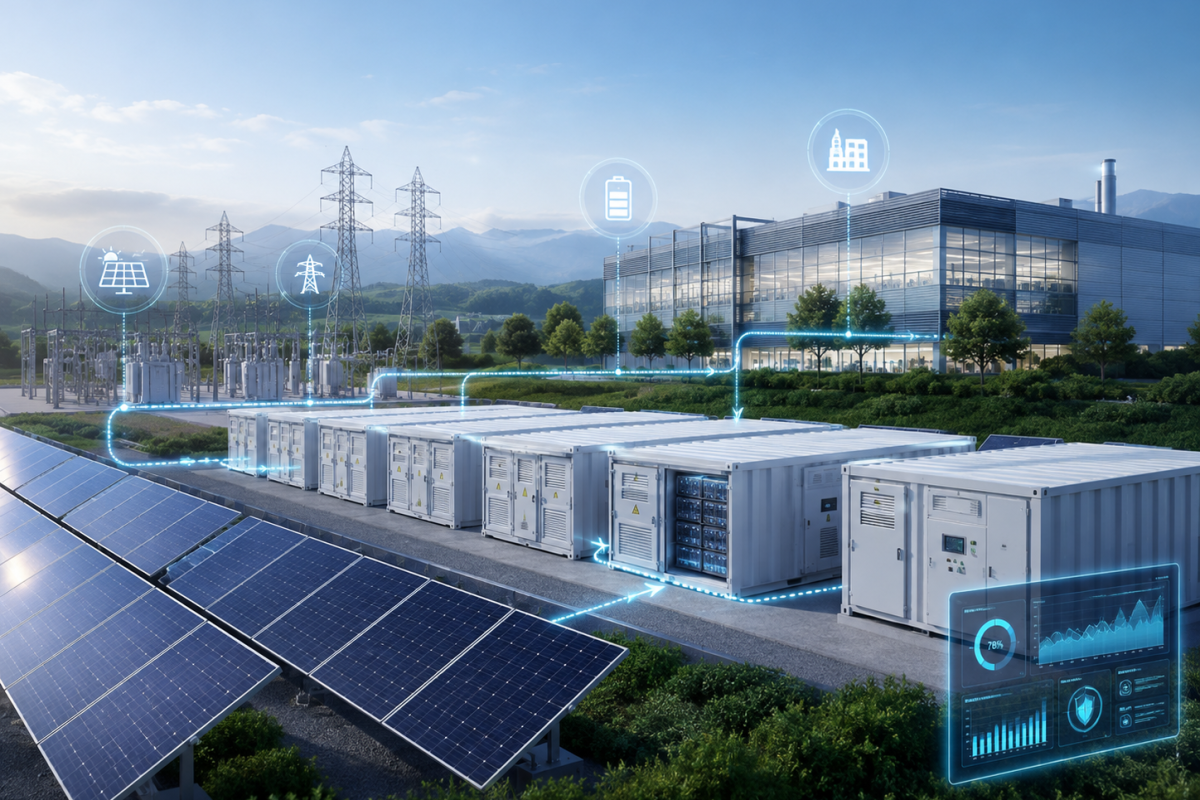
This is why photovoltaic systems are increasingly combined with a Battery Energy Storage System – BESS, allowing surplus energy to be stored and used later.
When properly engineered and managed through an EMS, a combination of solar generation + BESS + the utility grid can create a more flexible energy infrastructure capable of responding to changing generation, consumption and power interruptions.
Why is solar alone not enough?
Solar production is highest when generation conditions are favourable.
That does not necessarily mean that the facility is consuming the most electricity at the same time.
A typical profile may look like this:
- demand increases in the morning,
- photovoltaic production reaches high levels around midday,
- part of the generated energy may not be required immediately,
- solar production falls later in the day,
- electricity demand may remain high.
Without storage, surplus generation and later consumption have to be managed separately.
BESS allows part of this time imbalance to be compensated.
How do solar and BESS work together?
When photovoltaic generation exceeds current site demand, the EMS can direct surplus electricity into the battery system.
The energy remains stored until it is needed later.
For example:
Solar → facility consumption → surplus → BESS
When solar output decreases, stored energy can be supplied back to the facility:
BESS → facility consumption
Depending on the architecture, the utility grid, generators or other local sources can also form part of the same energy flow.
Increasing solar self-consumption
One of the main benefits of combining photovoltaic generation with BESS is the ability to increase the proportion of locally generated energy that is consumed on site.
Without storage, a facility can directly use only the solar electricity generated at the same time as demand occurs.
BESS shifts part of that energy in time.
This can help:
- increase solar self-consumption,
- reduce grid consumption during other periods,
- use the existing photovoltaic system more effectively.
The financial benefit always depends on the actual load profile, BESS operating strategy, tariffs and other site-specific conditions.
Reducing demand peaks
BESS can also be used for peak shaving.
When several high-power loads operate simultaneously, the site’s instantaneous demand may rise sharply.
The battery can temporarily provide part of the required power.
This can be useful for facilities operating:
- large motors,
- compressors,
- production lines,
- refrigeration systems,
- electric furnaces,
- high-power EV charging.
Battery storage therefore serves not only as an energy reserve but also as an active power-management tool.
What happens during a grid outage?
A common question is whether solar and battery storage can keep a facility operating during a utility outage.
They can — but only when the system has been specifically engineered for backup or island operation.
Simply installing photovoltaics and a battery does not automatically mean that the facility will remain powered after the grid fails.
The project needs to address:
- safe disconnection from the utility network,
- creation of a stable local electrical network,
- voltage and frequency control,
- operating-mode transfer,
- selection of critical loads,
- available BESS power,
- required backup duration.
These parameters determine what the system can actually support during an outage.
Not every load needs to remain online
In many projects, sizing a battery to support the entire industrial facility is neither technically nor economically optimal.
It is often more effective to define critical loads.
These may include:
- control systems,
- servers and communication infrastructure,
- security equipment,
- pumps,
- selected production equipment,
- emergency lighting,
- technologies that cannot be stopped abruptly.
The required BESS capacity can then be calculated based on the power of these loads and the required backup duration.
Power and capacity must be sized independently
At least two fundamental parameters have to be considered when designing a BESS.
Power – kW or MW
This determines how much power the storage system can deliver at a specific moment.
Energy capacity – kWh or MWh
This determines how long the system can continue delivering that power.
A facility that needs to cover a brief high-power peak requires a different BESS configuration from one that needs to operate critical loads for several hours.
The correct battery system therefore cannot be selected based on a single catalogue figure.
EMS: the brain of the energy system
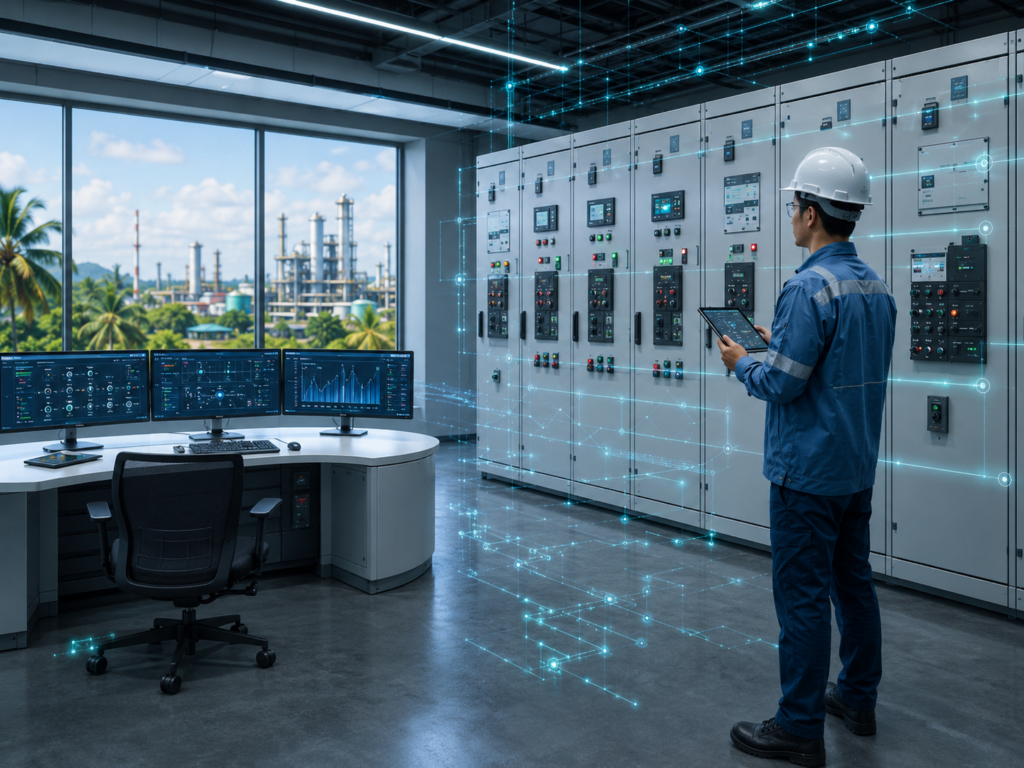
Energy flows are coordinated by the Energy Management System – EMS.
An EMS can continuously monitor:
- photovoltaic production,
- current facility demand,
- BESS state of charge,
- grid import or export,
- output of individual sources,
- generator status,
- available operating reserves.
The control system then decides which action has priority.
For example:
- supply current demand directly from solar;
- store surplus generation in the BESS;
- discharge the BESS during a demand peak;
- maintain a defined battery reserve for backup;
- supplement available energy from the grid or another source when required.
BESS, solar and generators in one system
More complex industrial facilities may contain significantly more than solar, battery storage and a utility connection.
The energy infrastructure may also include:
- generator or cogeneration units,
- diesel generators,
- additional local generation sources,
- multiple transformers,
- several distribution levels.
These sources need to be coordinated rather than operated as completely independent systems.
EMS/SCADA can manage their operation according to current conditions and defined priorities.
What can a normal operating day look like?
Consider an industrial facility equipped with solar and BESS.
Morning
Demand increases while solar production gradually rises.
The utility grid supplies the difference.
Midday
Solar generation exceeds current facility demand.
The EMS directs the surplus into battery storage.
Afternoon peak
Demand increases sharply.
The BESS supplies part of the required power and reduces instantaneous grid demand.
Evening
Solar production falls.
Depending on the control strategy, the facility can use part of the stored battery energy.
Utility outage
If the system is designed for island operation, automation separates the facility or selected circuits from the grid and maintains power to predefined critical loads.
Transition to island operation must be engineered
One of the most technically important parts of the project is the response to a grid outage.
Automation must safely identify the fault and execute the required sequence.
A simplified sequence may look like:
outage detection → grid separation → non-critical load shedding → activation of local sources → island network stabilisation
When the utility network returns, the reverse process has to occur, including safe reconnection or synchronisation according to the specific architecture.
These functions need to be designed in advance and tested during commissioning.
SCADA provides the complete energy picture
EMS determines how the energy system operates. SCADA gives operators visibility into what is happening.
An operator can monitor:
- current energy flows,
- photovoltaic generation,
- BESS output,
- battery state of charge,
- utility-grid consumption,
- active alarms,
- historical trends,
- status of individual energy sources.
The result is no longer a collection of independent devices with separate control panels.
It becomes one integrated monitoring and control environment.
Why is simply buying solar and a battery not enough?
One of the most common mistakes is to treat the project as the purchase of two separate pieces of equipment.
A reliable system requires analysis and engineering of:
- the facility load profile,
- photovoltaic generation profile,
- BESS power and capacity,
- critical-load requirements,
- required backup duration,
- electrical architecture,
- protection systems,
- automation,
- communications,
- EMS control logic,
- island operation,
- return to normal grid-connected operation.
The quality of the complete system depends on how these components interact.
INFOCOM: from energy assessment to an integrated EMS/SCADA platform
INFOCOM approaches solar and battery projects as complete energy-management systems.
A project can include:
- analysis of existing electrical infrastructure,
- assessment of consumption profiles,
- system architecture design,
- BESS sizing,
- critical-load definition,
- development of control algorithms,
- integration of local generation sources,
- EMS and SCADA integration,
- commissioning support.
Depending on the project, the common platform can integrate photovoltaics, BESS, generator or cogeneration units, diesel generators and the external utility grid.
The objective is not simply to generate or store electricity
Modern energy infrastructure needs to respond dynamically to changing conditions.
At one moment, the priority may be maximising solar self-consumption. At another, it may be limiting peak demand. Later, preserving battery energy as an emergency reserve may become more important.
This is why system control is just as important as the physical equipment.
Solar + BESS + EMS/SCADA create an energy system capable of generating, storing, distributing and managing electricity according to the real-time requirements of the facility.
That is the difference between installing individual technologies and building genuinely intelligent energy infrastructure.